



Business landscapes change a lot when industry reshaping innovations come along. These breakthroughs challenge old ways and create new market rules.
Clayton Christensen, a Harvard professor, first talked about disruptive innovation. He showed how simpler, more accessible technologies can take over from market leaders.
These innovations start by serving customers who are often ignored. They get better over time until they meet the needs of everyone. This changes how companies compete.
Knowing what disruptive technology definition means helps businesses see changes coming. It gives them important clues on how new players can change whole industries.
Understanding What Is Considered Disruptive Technology
To really get how new ideas change whole industries, we need to look at the theory behind disruptive technology. This starts with key research that’s a big part of studying innovation all over the world.
The Theoretical Foundations of Disruptive Innovation
Clayton Christensen’s pioneering research
Clayton Christensen, a professor at Harvard Business School, changed how we see innovation in the mid-1990s. His work gave us a clear way to spot technologies that really change how markets work. The Clayton Christensen theory came from watching how new companies beat the big players in different fields.
Christensen showed that new, disruptive ideas usually come from outside the top companies. These newcomers find opportunities that the big players miss. This is why big companies often can’t see the threats coming until it’s too late.
Distinguishing between sustaining and disruptive technologies
The big difference between sustaining vs disruptive innovations is how they approach the market. Sustaining tech makes current products better for existing customers. Disruptive tech, on the other hand, creates new markets or finds customers that were ignored before.
Related Posts:
- How to Make a Technology From Concept to Real-World…

- What Are Next Generation Technologies AI Quantum and Biotech

- How Many Lives Has Medical Technology Saved The…

- What are Front End Technologies? Your Complete Guide…

- Did We Have the Technology to Go to the Moon The…

- Have Humans Become Too Dependent on Technology The…

Sustaining innovations offer better features or performance for what customers already want to pay for. Disruptive innovations might start off worse but offer something new like being cheaper or easier to use.
Defining Characteristics and Parameters
Market accessibility and affordability criteria
Disruptive tech makes products or services more accessible to more people. This is done by making things simpler, cheaper, or through new business models. This way, more people can afford what was once only for the rich or tech-savvy.
This change creates new markets or brings in customers who couldn’t afford or access similar products before. This pattern is seen in many areas, like computers, cars, and energy.
Performance trajectory patterns
Disruptive innovations often start off worse than what’s already out there but get better faster. They eventually meet and then beat the needs of the mainstream market.
This pattern is why big companies often ignore new tech at first. They don’t meet the high standards of current customers. But, these new technologies quickly catch up and surpass the old ones in all areas.
Business model innovation requirements
For disruptive innovation to succeed, new business models are often needed. New tech requires different ways to make money, sell products, or reach customers.
These new business models are just as key as the tech itself. They help companies make money from markets that the big players find unprofitable or uninteresting.
| Characteristic | Sustaining Innovation | Disruptive Innovation |
|---|---|---|
| Market Focus | Existing customers | New or overlooked markets |
| Initial Performance | Meets current standards | Often inferior initially |
| Improvement Trajectory | Gradual enhancements | Rapid performance gains |
| Business Model | Established approaches | Frequently innovative |
| Market Impact | Incremental changes | Market transformation |
The characteristics of disruptive tech include their ability to create new value networks and eventually displace established market leaders. Companies like Cobre Montana show how these ideas work in old industries like mining.
Knowing these basics helps us spot disruptors before they change whole industries. Christensen’s research gives us valuable insights for investors, entrepreneurs, and big companies.
Identifying Hallmarks of Industry-Transforming Technologies
To spot disruptive innovations, we must look for their unique traits. These technologies don’t just compete; they change entire industries. They do this through new patterns of adoption and economic shifts.
Market Creation Versus Market Competition
Disruptive technologies often start new markets, not just compete in old ones. This marks a big change from traditional ways of competing.
New consumer base development
True disruption brings in new customers. Smartphones, for example, didn’t just replace old phones. They opened up a huge market for people who never had mobiles before.
This happens when tech makes products more accessible, cheaper, or more useful for new groups.
Value network reconfiguration
These technologies change how value flows in supply chains and business systems. Streaming services, for instance, changed how we watch content. They reorganised production, distribution, and how money is made.
Old ways like broadcast networks and physical media became less important. New digital networks took their place.
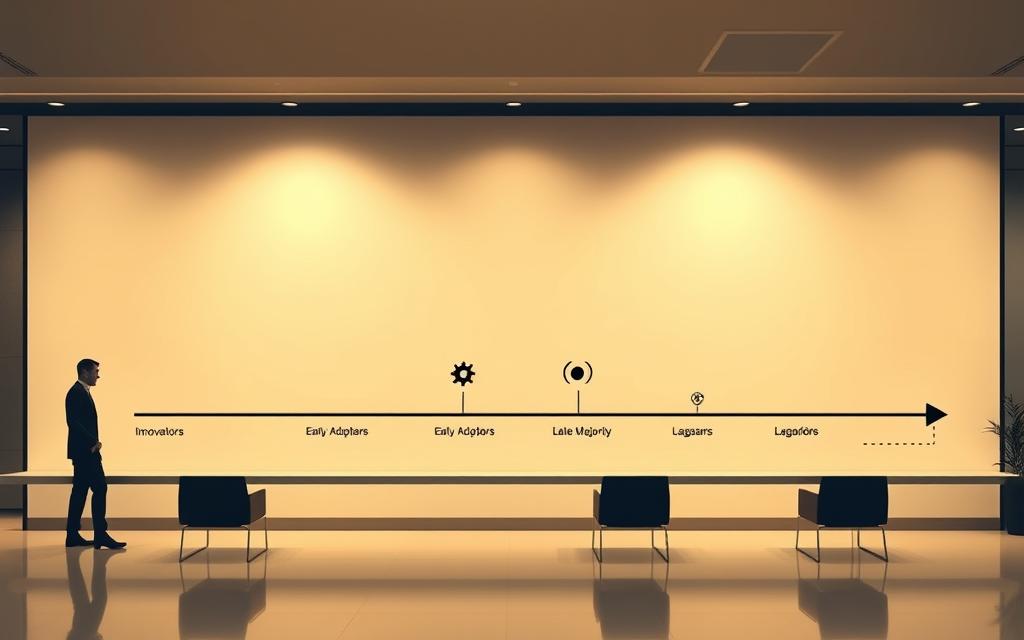
Technology Adoption Lifecycle Patterns
The journey from new idea to widespread use follows certain patterns. Knowing these patterns helps spot technologies with big impact.
Early adopter versus mainstream market penetration
Disruptive tech first wins over early adopters who value new features. These users give feedback and show how the tech works in real life.
When the tech gets better, cheaper, and easier to use, it reaches more people.
Crossing the chasm strategies
The biggest challenge is getting from early adopters to the mainstream. Companies need special plans to make this happen.
These plans often mean making things easier to use, cheaper, and showing clear benefits beyond being new.
Economic and Business Model Indicators
Transformative tech changes how businesses work and make money. These changes often show if a tech is truly disruptive.
Cost structure transformation
Disruptive tech often changes how much things cost. Cloud computing, for example, made IT costs variable, not fixed.
This change lets new business models emerge. It makes tech affordable for places that couldn’t afford it before.
Revenue model innovation
True disruption often brings new ways to make money. Moving from selling products to subscriptions is a big change.
Companies like Netflix and Spotify started this shift. They created a new way to make money that changed how we think about entertainment.
| Disruption Indicator | Traditional Approach | Disruptive Approach | Example |
|---|---|---|---|
| Market Focus | Existing customers | New customer segments | Digital cameras creating casual photography market |
| Value Delivery | Linear supply chains | Networked ecosystems | App stores connecting developers and users directly |
| Revenue Model | One-time sales | Recurring subscriptions | Software-as-a-Service replacing perpetual licenses |
| Adoption Pattern | Gradual improvement | Chasm crossing | Electric vehicles moving from niche to mainstream |
These signs help spot tech with real disruptive power before it’s widely known. By watching for these signs, businesses can get ready for big changes.
Contemporary Examples Across Major Sectors
Across the globe, new technologies are changing markets in big ways. They bring better efficiency, easier access, and new business models. These changes are real and happening now.
Digital Transformation Technologies
Cloud computing is a big example of how tech can change things. Amazon Web Services has made IT better by letting businesses use resources as they need them. This means no big upfront costs.
Old data centres are being left behind as companies move to the cloud. This change lets businesses focus on what they do best, not on managing IT.
Cloud computing: Amazon Web Services revolutionising IT infrastructure
AWS changed how we use technology by making it easy to get computing power when you need it. Businesses can now use top-notch infrastructure without having to own it. This makes it easier to grow and reach more people.
Streaming services: Netflix disrupting traditional media
Netflix changed TV and movies by letting people watch what they want, when they want. It brought new ways of watching and new kinds of shows. Now, everyone wants to watch things online.
“The streaming revolution didn’t just change how we watch content—it changed what content gets produced and how it reaches audiences.”
Artificial Intelligence and Automation
AI is changing many industries in big ways. It can do things that humans can’t, like learn and adapt. This makes it very powerful.
OpenAI’s ChatGPT transforming content creation industries
ChatGPT can write, code, and translate like a human. It’s changing how we create content. Now, people use AI to help with ideas and editing.
Automated manufacturing: Boston Dynamics’ robotics
Boston Dynamics makes robots that can do jobs that are hard or dangerous for humans. These robots work in places that are not safe for people. They help make things better and safer.
Financial Technology Innovations
Finance is changing fast with new tech. New ways of paying and banking are coming. People want to do things online and expect it to be easy and safe.
Blockchain: Bitcoin challenging traditional banking systems
Bitcoin uses blockchain to make money transfers safe and easy. It doesn’t need banks to work. This is a big change for how we think about money.
Mobile payments: Apple Pay and contactless transactions
Apple Pay makes paying with your phone easy and safe. It uses special codes to protect your money. Stores all over the world are now using this way of paying.
| Technology | Industry Impact | Key Innovation | Adoption Rate |
|---|---|---|---|
| Cloud Computing | IT Infrastructure | On-demand scaling | Enterprise widespread |
| Streaming Services | Media & Entertainment | Content personalisation | Consumer mass adoption |
| AI Language Models | Content Creation | Natural language generation | Rapid professional adoption |
| Blockchain Systems | Financial Services | Decentralised verification | Growing institutional interest |
| Electric Vehicles | Automotive | Sustainable transportation | Accelerating consumer shift |
Energy and Sustainability Technologies
New tech in energy is good for the planet and saves money. It uses clean energy and makes using energy more efficient. This is a win for both the environment and our wallets.
Tesla’s electric vehicles and energy storage solutions
Tesla is leading the way with electric cars and energy systems. Their batteries help homes and grids use clean energy. This is changing how we think about energy.
Solar panel efficiency: First Solar’s thin-film technology
First Solar made solar panels that work better and cost less. These panels make more electricity in different weather. This makes solar power a strong competitor to old energy sources.
Every example shows how new tech is making new markets and changing old ones. It’s all about making things better, easier, and more sustainable.
Framework for Recognising Disruptors
Finding technologies with disruptive power needs a detailed plan. A strong disruptor recognition framework looks at market trends, tech abilities, and outside factors together.

Market Signal Analysis Techniques
Spotting market signals is key to early recognition. These signs warn of new tech gaining ground.
Early adoption pattern recognition
Seeing where new tech first wins over users is insightful. Disruptors often start in small markets or with specific groups before spreading wide.
For example, Airbnb started with people at conferences who couldn’t find hotel rooms. This shows how solving specific problems can hint at big changes.
Investment trend analysis
Watching where money goes shows interest in new tech. Venture funds, corporate investments, and grants are key signs.
When money suddenly goes up for certain tech, it often means big changes are coming. This money shows belief in the tech’s future growth.
Technology Readiness Assessment
Looking at tech’s real abilities is just as important as market signs. Technology readiness checks how well it works now and how it might in the future.
Performance improvement trajectories
Disruptive tech gets better fast and stays affordable. Watching how it improves helps spot future leaders.
For example, electric car batteries have kept getting better and cheaper over time.
Scalability potential evaluation
It’s important to see if tech can grow beyond its first uses. True disruptors can adapt to many areas.
Cloud computing grew from simple storage to full business solutions because of its flexible design.
Regulatory and Environmental Scanning
The outside world affects how tech is adopted. Scanning the environment finds both hurdles and boosts for new tech.
Policy landscape analysis
Government rules can help or hurt new tech. Looking at laws helps predict legal issues and find supportive policies.
For instance, green energy got boosts from subsidies and climate goals in many places, speeding up its use.
Social acceptance factors
How people feel about new tech affects its adoption. Social media, news, and surveys give clues.
Electric cars became more accepted thanks to green campaigns and famous supporters, making them more welcome in the market.
| Assessment Area | Key Indicators | Evaluation Methods | Potential Impact |
|---|---|---|---|
| Market Signals | Early adoption rates, investment patterns | Data analytics, trend analysis | High predictive value for market entry timing |
| Technology Readiness | Performance metrics, scalability features | Technical benchmarking, architecture review | Determines implementation feasibility |
| Regulatory Environment | Policy support, legal frameworks | Legislative analysis, compliance assessment | Identifies adoption barriers and enablers |
| Social Factors | Public perception, cultural alignment | Sentiment analysis, survey research | Predicts adoption speed and market reception |
This detailed plan helps companies spot disruptors early. It lets them plan ahead instead of just reacting. This mix of views gives a full picture of new tech and its impact.
Navigating the Disruptive Technology Impact on Modern Business
Disruptive technologies are changing industries by targeting new market segments or creating new ones. Clayton Christensen’s framework helps us see how these innovations change the game. We see this impact in areas like AI and renewable energy.
Businesses need to spot the signs of industry change to stay ahead. Look out for new market creation, unique business models, and tech adoption. This summary highlights the importance of staying alert and adapting strategically.
Future innovations will come from ongoing research and focusing on what customers want. Companies should invest in new tech and be agile. Knowing how to navigate these changes helps businesses thrive, not just survive.
FAQ
What is disruptive technology?
Disruptive technology changes industries by creating new markets or replacing old ones. It starts by targeting areas that are often overlooked. It offers simpler and more affordable solutions, eventually changing entire sectors.
How did Clayton Christensen contribute to the concept of disruptive innovation?
Clayton Christensen introduced the idea of disruptive innovation. He showed the difference between sustaining innovations and disruptive ones. Sustaining innovations improve existing products, while disruptive ones create new markets or appeal to new customers with simpler, more affordable options.
What are the key characteristics of disruptive technologies?
Disruptive technologies focus on being easy to use and affordable. They start in niche markets and may not perform as well as established products at first. But, they improve over time and eventually outperform them, often with new business models.
How do disruptive technologies differ from sustaining innovations?
Sustaining innovations make existing products better for current customers. Disruptive innovations create new markets or serve segments ignored by mainstream providers. They start with lower performance but improve quickly, eventually beating established products.
Can you provide examples of disruptive technologies in recent years?
Sure. Amazon Web Services changed IT with cloud computing. Netflix disrupted media with streaming. OpenAI’s ChatGPT is changing content creation. Blockchain and Bitcoin are challenging traditional finance. Tesla is advancing electric vehicles and energy storage. Mobile payment systems like Apple Pay are changing transactions.
What hallmarks help identify industry-transforming technologies?
Look for new market creation, not just competition in existing ones. Check for changes in value networks and unique adoption patterns. Also, look for innovations in economic and business models, like subscription services or cost reductions.
How can businesses recognise potentially disruptive technologies early?
Businesses should watch for early adoption in niche segments and analyse investment trends. They should assess technology readiness and scalability. Scanning regulatory and social environments also helps. Understanding performance trajectories and anticipating policy challenges is key.
Why is it important for companies to understand disruptive technology?
Understanding and adapting to disruptive technologies is vital for staying competitive. Companies that ignore these innovations risk becoming obsolete. Those that embrace change can grow, lead, and transform industries.
How do disruptive technologies impact traditional industries?
They often replace established players, redefine value chains, and introduce new consumer behaviours. They force industries to innovate or adapt. Sectors like media, finance, manufacturing, and energy have seen major changes due to technologies like streaming, blockchain, automation, and renewable energy.
What role do business models play in disruptive innovation?
Business model innovation is key to disruption. It allows technologies to reach new audiences or operate more efficiently. Examples include Netflix’s subscription model, Tesla’s direct sales, and platforms like Uber and Airbnb that use sharing economy principles.
